
From Premium Ingredients To High-Energy Kibble – How Many Technical Secrets Lie in A Modern Extrusion Line?
Jul 24, 2026
More and more pet owners are paying close attention to the quality of their pets' staple food. Among the many types of pet food, extruded kibble has become the market mainstream thanks to its excellent palatability, stable nutrition, and high safety. But have you ever wondered how those uniform, crispy cat and dog kibbles are transformed from grains? Today, we take you into a professional pet feed processing plant to unveil the key equipment and process logic behind every step – from raw materials to finished products.
The Formulation: A Precise Science
Pet food formulas are built on precise nutritional science. Based on the nutritional needs of pets, ingredients are generally divided into several categories:
Energy base: Corn, rice, wheat, brown rice, and other cereals provide carbohydrates and form the structural skeleton for expansion.
Protein sources: Chicken meal, fish meal, meat and bone meal, soybean meal, etc., determine the amino acid balance of the final product.
Fats and oils: Chicken fat, fish oil, vegetable oils, etc., supply essential fatty acids and enhance palatability.
Functional additives: Vitamin premixes, minerals, prebiotics, fiber, etc., support overall health and digestion.
Before entering the production line, these raw materials undergo strict cleaning and screening to remove impurities, ensuring every batch is clean and safe. Though a basic step, it determines the stability of all subsequent processes.
From Powder to Pellet – An Interlocking Process
Let's take a typical twin‑screw wet‑extrusion line as an example and break it down step by step.

① Fine Grinding – Hammer Mill
Different raw materials need to be ground to a specific fineness, usually 60–80 mesh or finer. The more uniform the fineness, the better the conditioning and extrusion results, and the smoother the pellet surface. This is accomplished by a hammer‑type micro‑grinder, which ensures good powder flowability and minimizes segregation.
② Precise Batching & Mixing – Batching Scale & Twin‑Shaft Paddle Mixer
Evenly blending a dozen or even dozens of trace ingredients is the key to ensuring nutritional consistency in every kibble. After automatic weighing by a computer‑controlled batching system, the ingredients enter a twin‑shaft paddle mixer. This equipment achieves high uniformity in a very short time, with low residue to prevent cross‑contamination.
③ Conditioning – The Magic Before Extrusion – High‑Efficiency Conditioner
The mixed powder is fed into a differential‑diameter conditioner or twin‑shaft conditioner, where steam and an appropriate amount of water are injected. The material is heated to 80–95°C, initiating starch gelatinization and protein denaturation, forming a warm, elastic "dough." This step sets the perfect stage for extrusion.
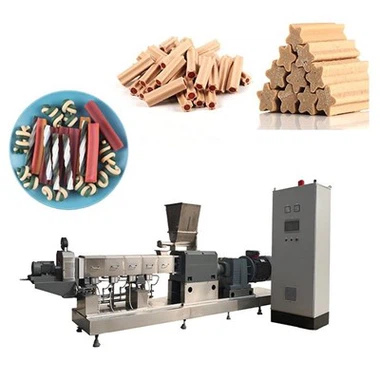
④ Core Process: High‑Temperature Instant Expansion – Twin‑Screw Extruder
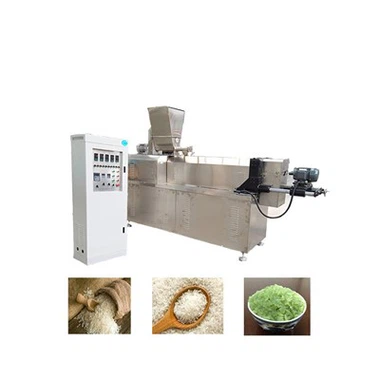
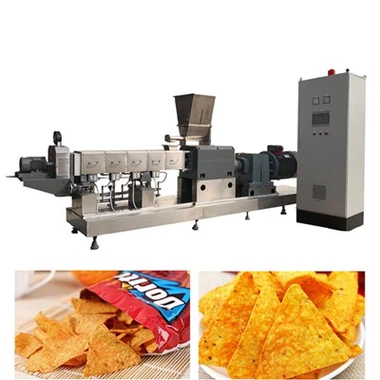
This is the heart of the entire line. The material is pushed into the barrel of the twin‑screw extruder, where it undergoes intense compression, shearing, and friction, causing temperature and pressure to rise sharply (up to 120–160°C and 30–40 atmospheres). As the pasty mass is forced out through the die holes, pressure is suddenly released, and superheated water vapor flashes into steam, causing the material to puff instantly into a porous, expanded pellet. A rotating knife cuts the pellets to preset lengths.
Equipment highlight: The twin‑screw extruder features self‑cleaning capability and stronger shear‑mixing effects, making it especially suitable for producing recipes with fresh meat slurries and high fat content, while offering flexible control over pellet shape and density.

⑤ Drying & Cooling – Belt Dryer & Plate Cooler
Freshly extruded pellets have high moisture content, high temperature, and soft texture. They are evenly spread on a continuous belt dryer, where multi‑layer conveying and zone‑controlled hot air gradually reduce moisture, set the pellet structure, and create crispness. They then enter a plate cooler to further balance internal and external temperature and moisture, preventing a dry‑outside, wet‑inside condition.
⑥ Flavor Enhancement & Nutrient Fortification – Drum Coater
After drying and cooling, the plain pellets enter a drum coating system. As the pellets tumble, liquid fats such as chicken fat or fish oil are atomized and sprayed on via high‑pressure nozzles, while heat‑sensitive nutrients like vitamins and flavorings are evenly dusted on. This locks in savory flavors while protecting heat‑labile ingredients.
⑦ Screening & Packaging – Vibrating Screen & Automatic Packager
Finally, finished pellets pass through a vibrating screen to remove fines and broken pieces, ensuring uniformity and integrity. The qualified kibbles are then weighed and filled by an automatic packaging machine, with nitrogen flushing or vacuum sealing to extend shelf life and prevent fat oxidation.
After such a rigorous process, extruded pet food offers advantages that traditional homemade or cold‑pressed diets find hard to match:
High digestibility: Fully gelatinized starch and moderately denatured protein make it easier on pets' digestive systems, improve nutrient absorption, and promote well‑formed stools.
Superior safety and hygiene: The high‑temperature, high‑pressure process eliminates harmful microorganisms like Salmonella and E. coli, meeting food‑grade safety standards.
Balanced nutrition in every bite: All ingredients are "locked" into a single pellet, preventing pets from picking out specific components.

Convenient storage and feeding: Dry, intact, and less prone to breakage, the kibbles work well with automatic feeders. Nitrogen‑flushed packaging extends shelf life while maintaining crispness.
Excellent palatability: The porous structure readily absorbs fats and flavor compounds, making the kibbles easy to bite and highly appealing to pets' preferences.
A seemingly simple kibble embodies a deep integration of ingredient science, equipment engineering, and quality control systems. A high‑quality extruded pet food line is not just about shaping raw materials – it is about precisely controlling temperature, pressure, time, and moisture to rebuild nutrition in a form that pets can access more easily.
We are dedicated to providing high‑quality pet food processing solutions – from individual machines to complete turnkey lines – helping our customers pack peace of mind and nutrition into every bag of pet food.