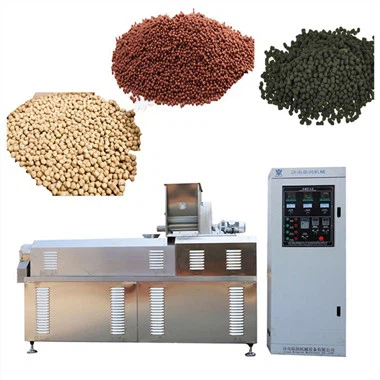

Extruder Choose Single Screw Or Double Screw
Feb 02, 2023
The extruder is mainly composed of a barrel and a screw rotating in the barrel, and there are two types of single-screw extruder and twin-screw extruder. In the extrusion process, materials enter the mold cavity from the feed mouth and are pushed forward by the screw, which will be squeezed, mixed, compressed and sheared. Due to the action of driving force, friction force, shearing force and external heating, the material becomes hot under pressure, reaches high temperature and high pressure, and ripens into a modified paste. When the material is extruded from the front die hole, due to the sudden drop of temperature and pressure to normal temperature and normal pressure, the water in the material will vaporize and evaporate rapidly, and the volume will expand rapidly to become an expanded substance.
Single-screw extruder
The screw of the single-screw extruder consists of a shaft connecting various screw units. The whole screw consists of three sections: feeding section, mixing section and melting homogenization section. After the material enters the barrel from the feeding mouth, it undergoes solid conveying, melting and homogenization in the screw, making the material change from loose state to continuous plastic dough.
In the single-screw extrusion cavity, the material is basically tightly around the screw, in a spiral continuous belt. When the screw rotates, the material moves forward along the screw like a nut. But when the friction between the material and the screw is greater than the friction between the material and the barrel, the material will co-rotate with the screw, which cannot realize the forward extrusion and transportation of the material. The higher the moisture and oil content of the material, the more obvious the trend will be. In order to avoid these problems, most single-screw extruders now use sectional, single-screw and double-screw, combined screw with staggered arrangement of pressure ring and kneading ring and inner wall grooving barrel to adapt to the change of materials in the machine cavity.
Twin-screw extruder
Twin-screw extruder is one of the multi-screw extruders, which is developed on the basis of single-screw extruder. In the barrel of the twin-screw extruder, two screws are placed side by side, so it is called twin-screw extruder. According to the relative position of the screw, it can be divided into meshing type and non-meshing type. The meshing type can also be divided into partial meshing type and full meshing type; According to the rotation direction of the screw, it can be divided into two types: the same rotation and the reverse rotation, and the reverse rotation can be divided into two types: inward and outward.
The properties of the pressure zone of the co-rotating twin screw are different. The material in the sleeve cavity is rotated by the screw, resulting in a high pressure zone and a low pressure zone. It is obvious that the material will flow from the high pressure zone to the low pressure zone in two directions: one is to form two C-shaped material flows along the inner wall of the sleeve along the rotation direction of the screw, which is the mainstream of the material; The other is to form counter-current through the clearance of the screw engagement part. The cause of countercurrent is that the left screw pulls the material into the meshing gap, while the right screw pulls the material out of the gap, resulting in the material moving forward in an "∞" shape and changing the direction of material flow. This is not only conducive to the mixing and homogenization of materials, but also causes grinding (i.e. shearing) and rolling between the teeth of the screw, resulting in the rolling effect, which is much smaller than the reverse screw rolling effect. Of course, if the rolling effect is small, the wear of the material on the screw will also be reduced. In this way, the material will be matured under the action of high temperature and high pressure after being transported, sheared, mixed and heated by the barrel shell, and finally squeezed out of the barrel.
The counter-rotating twin-screw extruder generally uses two screws with the same size but opposite thread direction. The difference between inward rotation and outward rotation is that the position of the pressure zone is different. The pressure generated by the inward rotation of the twin screw is high at the top and low at the bottom. When the material passes through the twin screw, it will generate extremely high pressure at the inlet, causing feeding difficulties. At present, this inward reverse rotation type is rarely used; The pressure generated by the outward rotation of the twin screw is high and low, which is conducive to feeding. However, compared with the same direction rotation, the C-shaped material flow formed by the material in the screw can not move from one screw to another, the mixing degree of the material is significantly reduced, and its self-cleaning ability is not as effective and stable as the same direction rotation twin screw.
Due to the pressure difference between the upper and lower parts of the counter-rotating twin screw, the separation force F that makes the screw shift to both sides is generated. Under the action of F, the screw presses against the barrel, which accelerates the wear of the barrel and the screw. The higher the rotating speed, the greater the F, the more serious the wear, thus limiting the rotating speed of the screw; While the co-rotating twin screw does not have the force to separate the two screws, so it has less wear, can run at high speed, and can achieve high output, so the co-rotating twin screw is widely used.
The heat source required by the material, except for the same part as the single screw, is mostly from the meshing clearance; The heat is generated and homogenized by the shearing, extrusion and mixing of the engaging thread. The size of the gap has a great impact on the extrusion quality. The gap is small and the shear force is large, but the amount of material passing through is reduced; The clearance is large, the amount of material passing through increases, but the shear force decreases. Double screw forced conveying and self-cleaning characteristics make the material stay in the barrel for a short and uniform time; The good mixing performance of the twin-screw makes the heat obtained by the material homogenize in time, accelerates the ripening degree of the material, reduces the fluctuation of the material temperature, and improves the output and quality of the expanded product.
The twin-screw extruder has the advantages of strong adaptability, sliding conveying and self-cleaning, but its structure is complex, the investment cost is high, and the corresponding maintenance and operation costs are also high. Therefore, twin-screw extruder is generally used in the production of aquatic products and pet feed with high added value; In addition, some special aquatic feeds, such as particulate aquatic feed, high-fat aquatic feed and feed with small production but constant formula, also need to be produced by twin-screw extruder.